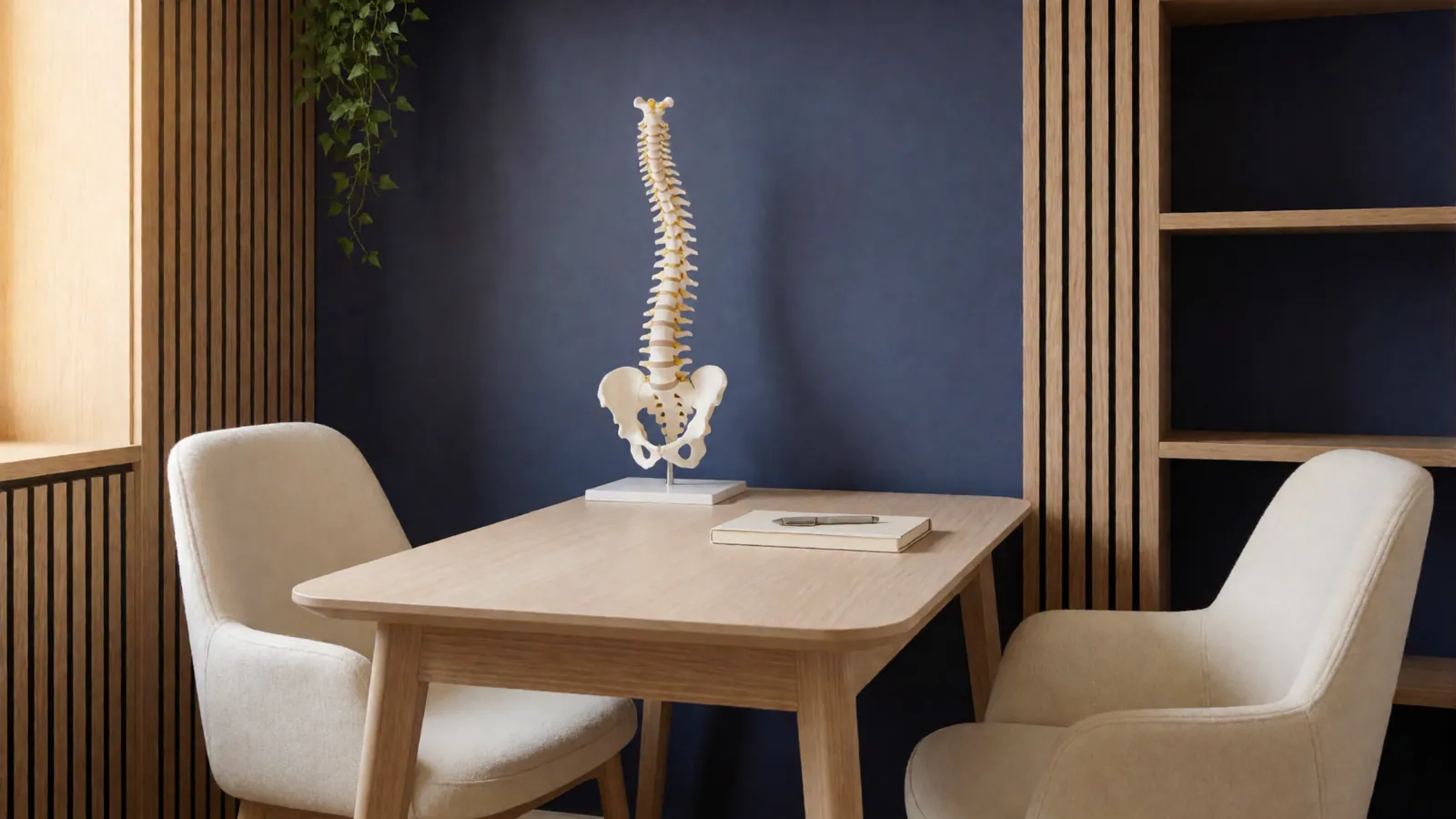
Some back and neck pain needs a doctor today, not a chiropractor. Some back and neck pain is not a case for a chiropractor and needs a doctor the same day. Go to an emergency room, not to us, if you have numbness in the groin or inner thighs, if you have lost control of your bladder or bowels, if a leg is becoming weak rather than just painful, if the pain followed a serious fall or a car crash, if you have a fever with back pain, if you have unexplained weight loss alongside it, if you have a history of cancer, or if a headache came on suddenly and is the worst you have ever had. We would rather you rang your doctor and never rang us at all.
Posture is the most heavily moralised topic in this field. People arrive convinced their spine is wrong, often having been shown a diagram with a red cross through it, and expecting to be told to stand up straight. The evidence is considerably less dramatic than the diagrams: the relationship between how somebody stands and whether they hurt is weak, plenty of people with textbook posture have persistent pain, and plenty of people with dreadful posture never have any.
What does relate to pain fairly consistently is duration. Any position becomes uncomfortable if you hold it long enough, because tissue loaded continuously without a break has no opportunity to recover. Nine hours at a screen is a problem regardless of how good the chair is, and the person who sits perfectly for nine hours is often no better off than the one who slouches and gets up every twenty minutes.
So this is not a page about correcting a shape. It is about three things that actually change how somebody feels: moving more often, building enough capacity in the neck, upper back and hips that ordinary positions stop being demanding, and setting up the environment so the default is less punishing. We will take photographs at the start and again at the end, because it is genuinely satisfying to see, and because people remember their starting point inaccurately.
What the evidence actually supports
Four corrections to what most people have been told.
There is no single correct posture
The idea of one ideal alignment that everybody should conform to does not hold up. Spines vary considerably between healthy, comfortable people, and the studies looking for a relationship between standing posture and pain keep finding a weak one. Being told your natural shape is wrong is both unhelpful and, for a lot of people, quietly distressing.
Duration is the real variable
How long you hold a position matters far more than which position it is. Tissue under continuous load without recovery becomes uncomfortable, and that is true of good positions as well as bad ones. This is why a timer is worth more than a chair, and why the single most effective instruction we give desk workers is to stand up every half hour.
Capacity changes the picture
A neck and upper back with reasonable strength and endurance tolerate a long day at a screen far better than weak ones do, and that is trainable. This is the part most posture advice skips entirely in favour of alignment cues, and it is the part with the most durable effect. It takes about ten minutes a day for eight weeks.
Forward head posture is not a disease
It is frequently pointed at, measured with impressive-looking apps, and used to sell long treatment plans. It is common in people with no symptoms whatsoever, its relationship with neck pain is much weaker than the marketing implies, and it does not require years of care to address. Be sceptical of anybody who builds a package around it.
What we actually do
Assess, build capacity, change the environment, and measure whether any of it worked.
Assess movement, not just shape
How much rotation does your neck actually have. Can your upper back extend. Can your hips move independently of your lower back. Can you hold a position under load without shaking after twenty seconds. These tell us far more than a photograph of you standing still, and they give us something that can be improved and re-measured.
Free what is stiff
Hands-on work through the upper back, the neck and the hips, which are the three areas most reliably restricted in people who sit for a living. This does not correct posture and it is not intended to — it makes movement easier and more comfortable, which makes the loading work and the frequent position changes actually happen.
Build what is weak
Deep neck strength, mid-back and shoulder blade endurance, hip strength. Short, specific, progressive, and about ten minutes a day. This is the part that produces a durable change in how a long day feels, and it is the part that gets skipped in favour of being told to sit up straight.
Photograph it, then photograph it again
We take standing photographs at the start and repeat them at the review, because memory for one's own starting point is unreliable and seeing the difference is motivating. We are honest about what the photographs mean, though: they show a change in habitual position, not proof that the change is why you feel better.
Things sold for posture that we do not recommend
Four popular purchases, and what we think of them.
Posture braces
They hold your shoulders back while you wear them and do essentially nothing once you take them off, and worn constantly they let the muscles that should be doing that job do less of it. There is a narrow case for brief use as a reminder while you build strength. As a solution they are a strap that costs forty dollars.
Expensive chairs, as a first purchase
A good chair is pleasant and it is not a treatment. People buy a thousand-dollar chair, keep sitting in it for nine hours without a break, and are surprised to still ache. Sort the break frequency and the screen height first — both are free — and then buy the chair if you want one.
Long correction packages
Programmes of forty or sixty visits sold upfront to correct spinal alignment, usually with dramatic before-and-after imagery. The alignment change these produce is modest, its relationship to symptoms is weak, and the payment structure is the giveaway. We do not sell packages of anything, for this or for anything else.
Standing all day instead
Standing desks are useful because they let you change position, not because standing is virtuous. Standing still for eight hours produces its own set of complaints, and people who switch entirely often trade neck ache for sore feet and legs. Alternate. The benefit is in the switching.
Posture Correction in western Queens
There is no single correct posture, and plenty of people with textbook posture are in pain. What actually helps is capacity, variety and how long you hold any one position.
Every course of care here starts the same way: a full hour, a proper history, an examination, and then a plain statement of what we think is going on and how confident we are about it. You are told what we propose, roughly how many visits it ought to take and what should have changed by when — and we agree a date to stop and look at whether it worked. If the honest answer at any point is that this needs somebody else, you get that instead, and we write to them the same week.
Chiropractic care is not a substitute for medical diagnosis. Chiropractic care is not a substitute for medical diagnosis, and nothing on this website is medical advice for your particular problem. We are not physicians: we do not prescribe medication, we do not perform surgery, and we do not treat disease. What we do is examine how your spine and joints move, work on them by hand, and give you something to do between visits. If your problem turns out to be outside that, we say so and refer you — which happens often enough that you should expect it as a normal outcome rather than a failure.
What chiropractic does not treat. We treat musculoskeletal problems: the spine, the joints, the muscles and the nerves that are irritated by them. We do not claim that adjusting a spine treats asthma, allergies, ear infections, colic, digestive disease, high blood pressure, infertility, immune function or any other internal illness. Chiropractors who make those claims are making them without good evidence, and you should be wary of anybody who does. If somebody has told you that spinal care will fix a condition on that list, we will tell you honestly that it will not.
Questions
Posture Correction — the questions we are asked most
Is bad posture causing my pain?
Probably less than you have been told. The relationship between standing posture and pain is weak: plenty of people with textbook alignment have persistent pain and plenty with dreadful posture have none. What relates far more consistently is how long you hold any one position without a break, and how much capacity the area has. Both of those are more fixable than your natural shape, and neither requires you to be told you are wrong.
Should I buy a posture brace?
Generally no. A brace holds your shoulders back while it is on and does close to nothing once it comes off, and worn continuously it lets the muscles that should be doing that work do less. There is a narrow case for brief use as a reminder while you build strength. As a solution to the problem, it is a strap. Put the money towards ten minutes a day of the right exercise instead.
Can you fix my forward head posture?
We can improve your neck's movement, strength and endurance, and habitual head position often changes along with that. What we will not do is tell you that forward head posture is a disease requiring forty visits. It is common in people with no symptoms at all, its link to neck pain is far weaker than the apps and diagrams suggest, and long packages built around it are selling the diagram rather than treating you.
How often should I get up from my desk?
About every thirty minutes, and it does not need to be long — standing up, walking to the window and back, and sitting down again is enough. The point is interrupting the continuous load rather than doing anything therapeutic. A timer is genuinely more effective than most equipment purchases, and it is the single instruction that most reliably changes how a desk worker's day feels.
Is a standing desk worth it?
Worth it for the ability to change position, not because standing is inherently better. People who switch to standing all day frequently trade a sore neck for sore feet and legs. The benefit is in alternating every half hour or so. If you have one, use it that way; if you do not, standing up regularly achieves most of the same thing for nothing.
Will you take x-rays to measure my posture?
No. We do not take x-rays here, and imaging somebody's spine to measure alignment for posture purposes is radiation exposure for something that can be assessed perfectly well without it — and it produces numbers whose relationship to symptoms is weak. We use standing photographs and movement measurements, repeat them at the review, and are honest about what they do and do not show.
Related
Often seen alongside this

Everyday & Life Stage
Prenatal Chiropractic
Side-lying, bolstered and low force, for the back, pelvis and hips that pregnancy makes ache. Nothing we do involves a twist through the abdomen, and we make no claims about the birth.
Read more
Everyday & Life Stage
Pediatric Chiropractic
Children get back and neck pain from sport, bags and falls, and that is worth looking at. We do not treat colic, reflux, ear infections, sleeping or behaviour, and we say so before you book.
Read more
Everyday & Life Stage
Care After Sixty
Thinner bone, stiffer joints and longer medication lists mean different hands. Dr. Halloran almost never twists anybody, and half of what he prescribes is about walking and balance.
Read moreA fee agreed before the visit, not after it
Book an appointment
Pick a chiropractor and an hour from the calendar — it shows only the times each of them genuinely has free. A first visit is a full hour and costs $95 for the examination on its own, or $145 if we treat you at the same appointment. You decide which after the examination, not before.