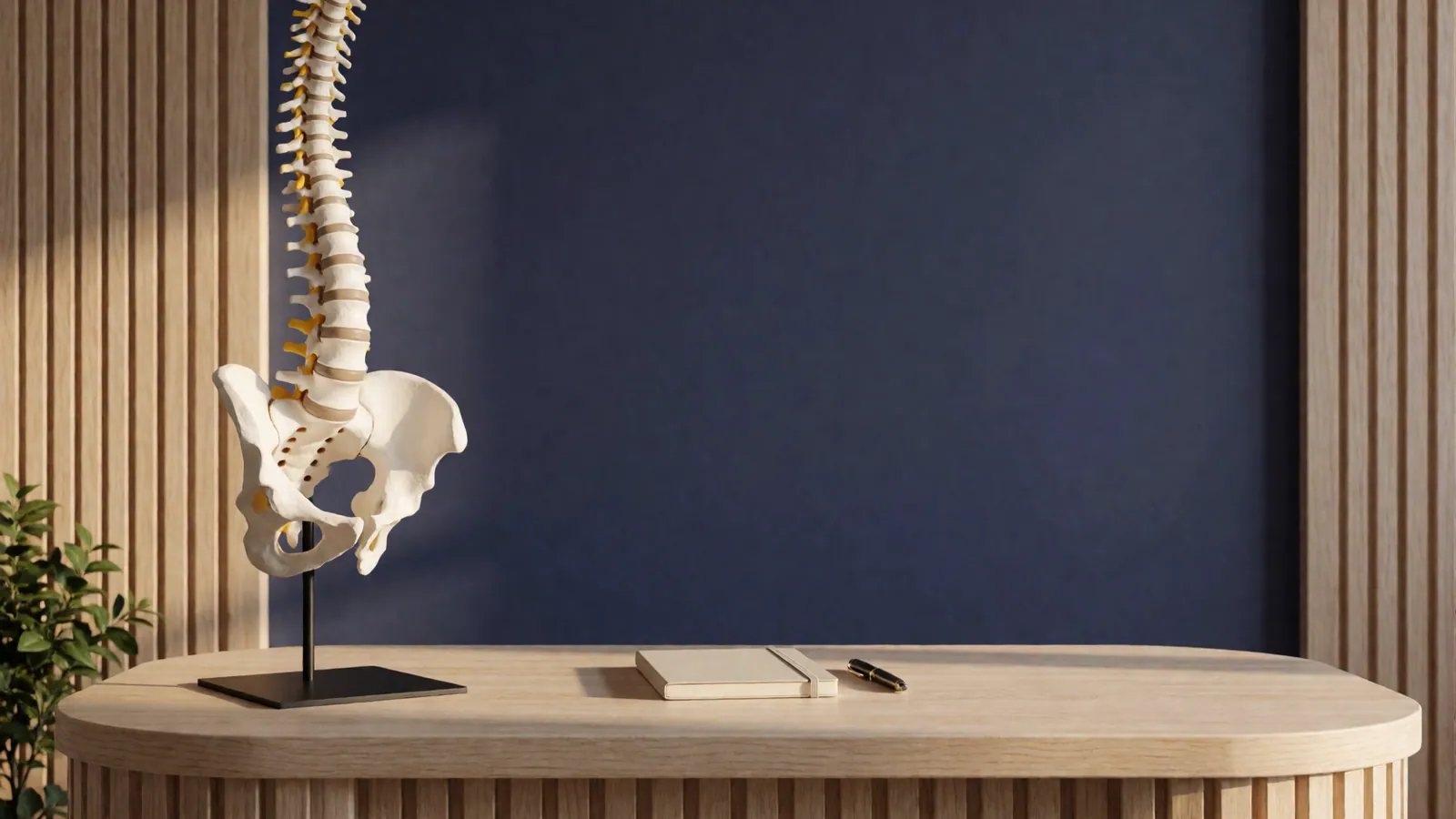
Some back and neck pain needs a doctor today, not a chiropractor. Some back and neck pain is not a case for a chiropractor and needs a doctor the same day. Go to an emergency room, not to us, if you have numbness in the groin or inner thighs, if you have lost control of your bladder or bowels, if a leg is becoming weak rather than just painful, if the pain followed a serious fall or a car crash, if you have a fever with back pain, if you have unexplained weight loss alongside it, if you have a history of cancer, or if a headache came on suddenly and is the worst you have ever had. We would rather you rang your doctor and never rang us at all.
The language around discs has done a lot of damage. A slipped disc sounds like something has come loose and needs putting back, and that image frightens people into stillness at exactly the moment movement would help them. A disc is a thick fibrous pad, firmly bonded to the vertebra above and below, and it does not slip anywhere. What happens is that the tough outer ring weakens or tears, the softer centre pushes into or through it, and the resulting bulge presses on and chemically irritates a nerve root running past.
Nobody can push that back in with their hands, and any clinic implying otherwise is overselling. What we can genuinely do is reduce the irritation, find the positions and movements that ease the pressure on the nerve, keep you moving so the rest of you does not deteriorate while the disc settles, and then progressively load the area so it tolerates ordinary life again. Alongside that, the disc itself is doing something useful on its own: herniations frequently shrink over months, and larger ones often shrink more.
The realistic timeline is longer than people want. Leg pain from an irritated root often improves substantially over six to twelve weeks, back pain lingers a while after that, and it is normal for progress to be uneven rather than a straight line. We agree a review date so that we are checking whether this is actually working rather than simply continuing, and we will say plainly when the answer is imaging or a surgical opinion instead of a fifteenth visit.

What we can and cannot do
The honest division, stated before you book rather than discovered afterwards.
We cannot put a disc back
No hands-on technique, no traction table and no instrument repositions disc material. Anybody who tells you they can reduce your herniation by hand is describing something that does not happen. What treatment can do is change how much the irritated nerve is being provoked, which is why people often feel considerably better long before any imaging would look different.
We can reduce the irritation
A nerve root that is inflamed as well as compressed responds to being provoked less. Finding the positions and movements that unload it, using comfortable techniques that do not aggravate it, and changing how you sit, sleep and travel all reduce the provocation. This is most of what makes the first month tolerable.
We can keep the rest of you working
The secondary damage from a disc injury is often the deconditioning: six weeks of guarding, avoiding and sitting still leaves the hips, trunk and legs measurably weaker, and that is its own problem to fix afterwards. Keeping you walking and moving through the painful phase is unglamorous and it materially changes where you are in three months.
We can tell you when to stop
The most valuable thing we do for some disc patients is send them somewhere else at the right moment. Progressive weakness, or severe pain that has not improved at all over six to eight weeks of sensible care, means imaging and a specialist opinion. That is a normal outcome and not a failure — and delaying it is the actual failure.
The treatment, in order
Calm it down, keep it moving, build it up. Skipping the third stage is why people get a second episode.
Flexion-distraction
A specialised table gently opens and closes the lower back while the chiropractor works with one hand. It is slow, comfortable, involves no thrust and is often the first hands-on technique tried for disc-related back and leg pain. It suits a lot of irritable backs that would not tolerate anything more vigorous, and you can do it early.
Traction and decompression
A motorised table applies slow, controlled lengthening through the lower back. It suits some disc-related problems well and does very little for others, and we will tell you which we think you are rather than selling you a course. Since we do not sell courses of anything, that conversation is simpler here than in most clinics. The spinal decompression page describes the table.
Directional movement
Most irritated nerve roots have a movement direction that eases symptoms. Repeated gentle movement in that direction, several times a day, is one of the better-evidenced things you can do for yourself with disc-related leg pain — and it costs nothing. Which direction is yours comes out of the examination, and it is not the same for everybody.
Progressive loading
Once the leg has calmed and symptoms are retreating up towards the back, the job changes completely: hips, trunk and posterior chain, loaded gradually and deliberately. A disc that is protected forever stays fragile forever. This stage takes months rather than weeks and it is the part that changes whether there is a next time.
Imaging and surgery
When a scan is worth having, and what it does and does not tell you.
Scans find things that do not hurt
Disc bulges, degeneration and annular tears turn up routinely on scans of people with no pain at all, and the proportion rises steadily with age. This is why scanning every sore back is unhelpful: it produces alarming words on a report that may have nothing to do with your symptoms, and frightened people move less and do worse.
When a scan changes the plan
Imaging earns its place when there are neurological signs, when red flags are present, when symptoms have not improved over six to eight weeks of sensible care, or when a surgical opinion is genuinely being considered. In those situations it changes what happens next, which is the only real test of whether a test is worth doing.
What surgery is for
Surgery for a herniated disc is very good at relieving leg pain quickly, and it does not have much advantage over conservative care by a year or two out — except for people with significant or progressing weakness, where it is a different conversation and a more urgent one. It is not a treatment for back pain alone.
How we refer
We write to your doctor with what we found, what we did and why we think a specialist opinion is needed, and we send it the same week rather than telling you to mention it at your next check-up. You are not charged for the referral, and we are perfectly happy to keep treating alongside a specialist if that is what everybody agrees on.
Disc Injury Care in western Queens
Discs do not slip and they cannot be put back by hand. What conservative care can genuinely do for a bulging or herniated disc, how long it takes, and when a surgeon is the right answer.
Every course of care here starts the same way: a full hour, a proper history, an examination, and then a plain statement of what we think is going on and how confident we are about it. You are told what we propose, roughly how many visits it ought to take and what should have changed by when — and we agree a date to stop and look at whether it worked. If the honest answer at any point is that this needs somebody else, you get that instead, and we write to them the same week.
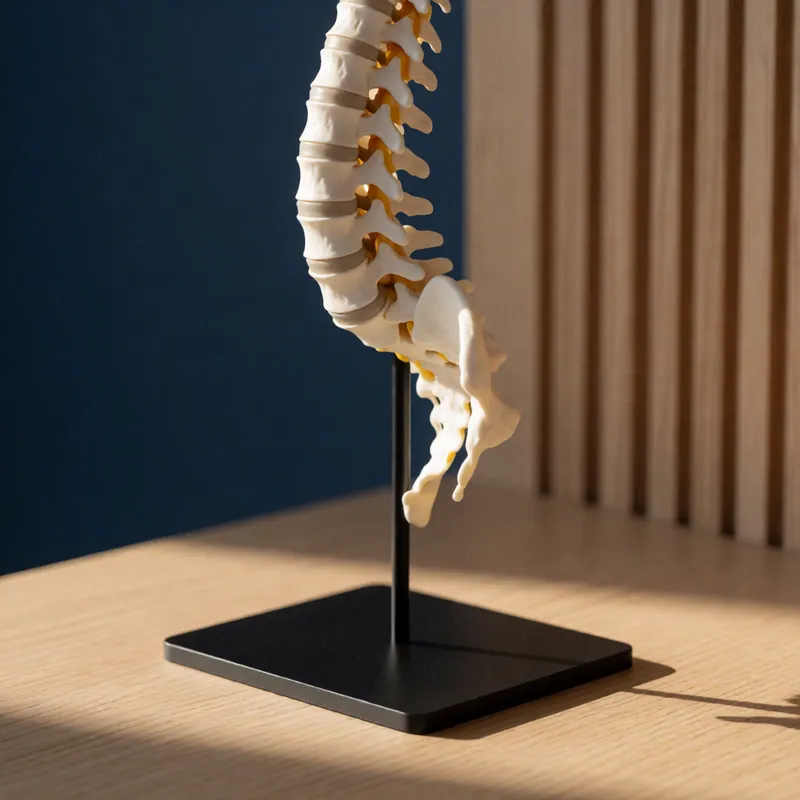
Chiropractic care is not a substitute for medical diagnosis. Chiropractic care is not a substitute for medical diagnosis, and nothing on this website is medical advice for your particular problem. We are not physicians: we do not prescribe medication, we do not perform surgery, and we do not treat disease. What we do is examine how your spine and joints move, work on them by hand, and give you something to do between visits. If your problem turns out to be outside that, we say so and refer you — which happens often enough that you should expect it as a normal outcome rather than a failure.
What chiropractic does not treat. We treat musculoskeletal problems: the spine, the joints, the muscles and the nerves that are irritated by them. We do not claim that adjusting a spine treats asthma, allergies, ear infections, colic, digestive disease, high blood pressure, infertility, immune function or any other internal illness. Chiropractors who make those claims are making them without good evidence, and you should be wary of anybody who does. If somebody has told you that spinal care will fix a condition on that list, we will tell you honestly that it will not.
Questions
Disc Injury Care — the questions we are asked most
Can you put my slipped disc back?
No, and neither can anybody else — a disc is firmly attached to the bones above and below it and does not slip out of place, so there is nothing to push back. Any clinic claiming to reduce a herniation by hand is overselling what treatment does. What can genuinely be changed is how much the nearby nerve is being irritated, which is why people often feel far better long before a scan would look any different.
Will my herniated disc heal on its own?
Frequently, yes. Herniations often shrink over months as the body reabsorbs the displaced material, and somewhat counterintuitively the larger ones often shrink more. That is the background process; treatment is about making the intervening months bearable, keeping you moving so the rest of you does not deteriorate, and then rebuilding capacity. Most people with disc-related leg pain get better without surgery.
Is it safe to be adjusted with a disc problem?
Some techniques are appropriate and some are not, and the examination decides which. Vigorous rotational manipulation of an acutely irritated nerve root is generally a poor idea. Flexion-distraction, mobilisation, traction and soft-tissue work are usually the better options, and none of them involves a thrust. If we do not think hands-on treatment is right for you this week, we will tell you that rather than treat you anyway.
How long before I can go back to the gym?
Sooner than most people expect, and differently from how they left. Total avoidance is not the goal — a back that is protected indefinitely stays fragile indefinitely. We usually reintroduce loading early with movements that do not provoke the leg, then build from there. What changes is the order, the range and the load for a while, not whether you train at all.
My scan says degenerative disc disease. Is that serious?
It sounds far worse than it is. That phrase describes ordinary age-related change in the discs and it turns up on scans of enormous numbers of people who have no pain whatsoever. It is not a disease in the way the name suggests and it is not progressive in the frightening sense. It is closer to describing grey hair than describing an illness, and it correlates poorly with how much anybody hurts.
Should I use a back brace?
Occasionally, briefly, for a specific reason — and not as a habit. A brace can help somebody get through a necessary task in the worst week. Worn continuously it lets the muscles that ought to be doing that job stop doing it, and you end up weaker than you started. If you have been wearing one for weeks, bring it in and we will work out how to get you out of it.
Related
Often seen alongside this

Spine & Nerve Pain
Chiropractic Adjustment
The technique the whole trade is named after: a short, shallow, quick movement through a stiff joint. It takes a fraction of a second, it is usually a relief rather than a pain, and it is not the only thing we do.
Read more
Spine & Nerve Pain
Lower Back Pain
The single most common reason anybody rings this clinic. Most of it is a joint and the muscle around it, most of it improves inside a few weeks, and most of it does not need a scan.
Read more
Spine & Nerve Pain
Neck Pain
A neck that will not turn, a shoulder that aches with it, and a headache creeping up the back of the skull. Treatable — and treatable without high-velocity manipulation if that is what you would prefer.
Read moreA fee agreed before the visit, not after it
Book an appointment
Pick a chiropractor and an hour from the calendar — it shows only the times each of them genuinely has free. A first visit is a full hour and costs $95 for the examination on its own, or $145 if we treat you at the same appointment. You decide which after the examination, not before.