
Some back and neck pain needs a doctor today, not a chiropractor. Some back and neck pain is not a case for a chiropractor and needs a doctor the same day. Go to an emergency room, not to us, if you have numbness in the groin or inner thighs, if you have lost control of your bladder or bowels, if a leg is becoming weak rather than just painful, if the pain followed a serious fall or a car crash, if you have a fever with back pain, if you have unexplained weight loss alongside it, if you have a history of cancer, or if a headache came on suddenly and is the worst you have ever had. We would rather you rang your doctor and never rang us at all.
Custom orthotics are moulded insoles made from an impression of your feet, designed to change how load is distributed as you stand and walk. They cost a few hundred dollars, they last a few years, and for a specific set of problems they genuinely help. That set is considerably narrower than the marketing around them suggests, and a great many people have been sold orthotics for problems that did not need them.
The honest version of the evidence is this: orthotics help some foot and lower limb pain, they have a reasonable role in certain foot types and certain conditions, and the claims that they correct posture, cure back pain or realign the body up the chain are far weaker than the confidence with which they are usually made. Somebody selling you insoles for a sore neck is selling you insoles.
So our approach is to try the cheap things first. Better shoes, a period of stronger hip and calf work, an off-the-shelf insole to test whether support changes anything at all — these are quick, they cost little, and they resolve a good proportion of the cases people arrive asking for custom orthotics for. When we do think custom orthotics are the right answer, we will say so and explain exactly why your presentation is one of the ones they suit.
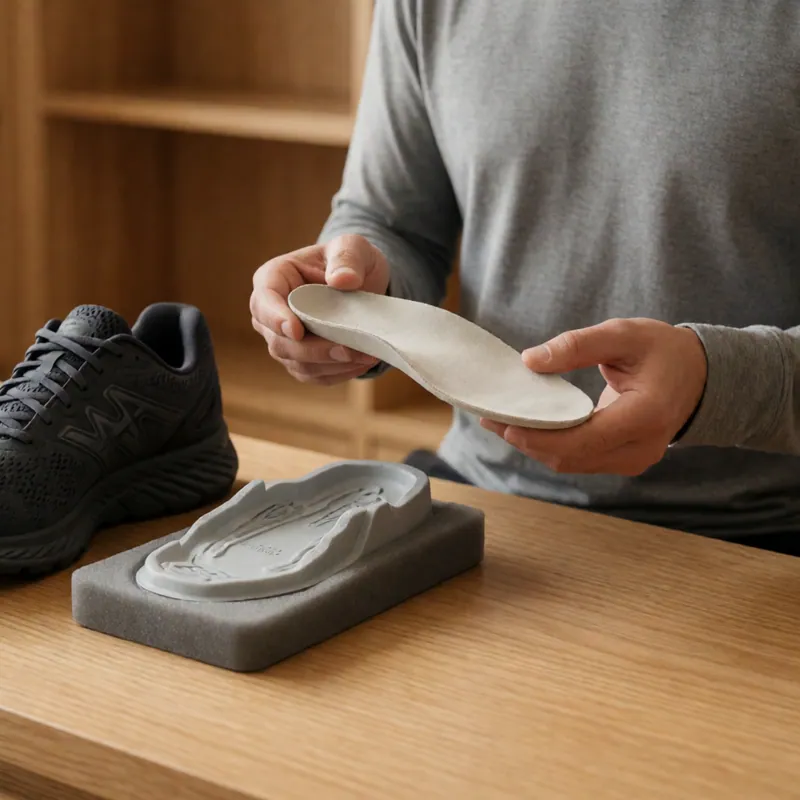
When they genuinely help
Four presentations where the case is reasonable.
Persistent foot pain
Pain under the heel or through the arch that has not responded to calf and foot loading, shoe changes and activity modification. This is the clearest use case: symptoms are in the foot, the intervention is in the shoe, and there is no long chain of assumptions in between. Try the loading first — it resolves a good proportion on its own.
A foot that collapses markedly
A foot with substantial and mobile flattening under load, particularly where symptoms clearly change when the arch is supported by hand or by a temporary insole. That test — does supporting it actually alter your symptoms — is worth far more than any photograph of a footprint, and we do it before recommending anything.
A real leg length difference
Where there is a genuine and measurable structural difference between the legs and it is contributing to symptoms, a heel raise can help. Note that small differences are extremely common, mostly harmless, and frequently blamed for problems they are not causing. Measurement matters here more than impression.
High-mileage load management
Runners and people on their feet all day sometimes benefit from redistributing load while a specific tissue recovers, as a temporary measure alongside the loading programme rather than as a permanent fixture. Used this way orthotics are a tool for a period rather than a prescription for life.
What to try first
All cheaper, all faster, and all resolve a fair proportion of the people who arrive asking for insoles.
Different shoes
The single most underrated intervention for foot and lower limb pain, and the cheapest. Shoes that are too old, too soft, too narrow or wrong for the activity account for a surprising share of what walks in. Bring the shoes you actually wear all day, including the ones you are embarrassed about, and we will look at them.
Stronger feet and calves
Calf and foot strength work resolves a good proportion of heel and arch pain on its own, and it builds something durable rather than adding a support the foot then relies on. It takes eight to twelve weeks and it costs nothing. For most people this is the first thing we prescribe, and for many it is the only thing needed.
An off-the-shelf insole, as a test
A twenty-dollar prefabricated insole is a legitimate diagnostic trial. If supporting the foot changes your symptoms meaningfully over a couple of weeks, that is evidence a custom device may be worth it. If it changes nothing at all, spending three hundred and forty dollars on a bespoke version of the same idea is unlikely to be the answer.
Fixing what is above the foot
Weak hips, poor calf capacity and a sudden increase in load cause a great deal of what gets blamed on feet. A knee that hurts because the hip is not controlling it does not need an insole, and giving it one leaves the actual problem in place. This is why we assess the whole chain before looking at the foot in isolation.
How the fitting works
If we do agree they are the right answer.
Assessment first
Standing and walking assessment, foot mobility and strength, footwear, and a clear statement of what specifically we expect the orthotic to change. If we cannot articulate what problem it is solving, it is not the right intervention — and that conversation happens before any impression is taken.
The impression
A foam impression box or a cast taken with the foot held in a specific position, which is then used to make the device. It takes about ten minutes and is mildly odd rather than unpleasant. Which position the foot is held in matters, and it is decided by what the assessment found.
Fitting and breaking in
They arrive in a couple of weeks and are fitted, checked in your actual shoes, and adjusted. You wear them for an hour or two a day at first and build up over a fortnight — going straight to full days reliably produces aching feet and a device that gets abandoned in a drawer.
Review
We check them a few weeks later against the specific thing they were meant to change. If they have not done it, that is worth knowing and worth acting on rather than quietly accepting. Adjustments are included; so is telling you honestly that they did not work.
Custom Orthotics in western Queens
Moulded insoles, made from an impression of your feet. Genuinely useful for a specific set of problems, considerably oversold for everything else, and not the first thing we reach for.
Every course of care here starts the same way: a full hour, a proper history, an examination, and then a plain statement of what we think is going on and how confident we are about it. You are told what we propose, roughly how many visits it ought to take and what should have changed by when — and we agree a date to stop and look at whether it worked. If the honest answer at any point is that this needs somebody else, you get that instead, and we write to them the same week.
Chiropractic care is not a substitute for medical diagnosis. Chiropractic care is not a substitute for medical diagnosis, and nothing on this website is medical advice for your particular problem. We are not physicians: we do not prescribe medication, we do not perform surgery, and we do not treat disease. What we do is examine how your spine and joints move, work on them by hand, and give you something to do between visits. If your problem turns out to be outside that, we say so and refer you — which happens often enough that you should expect it as a normal outcome rather than a failure.
What chiropractic does not treat. We treat musculoskeletal problems: the spine, the joints, the muscles and the nerves that are irritated by them. We do not claim that adjusting a spine treats asthma, allergies, ear infections, colic, digestive disease, high blood pressure, infertility, immune function or any other internal illness. Chiropractors who make those claims are making them without good evidence, and you should be wary of anybody who does. If somebody has told you that spinal care will fix a condition on that list, we will tell you honestly that it will not.
Questions
Custom Orthotics — the questions we are asked most
Do I really need custom orthotics?
Probably not, and we would rather establish that before you spend three hundred and forty dollars. Better shoes, eight to twelve weeks of calf and foot strengthening, and a twenty-dollar off-the-shelf insole as a trial resolve a good proportion of the people who arrive asking for custom devices. If those do not work and your presentation is one orthotics genuinely suit, we will say so and explain why.
Will orthotics fix my back pain?
Very unlikely, and the claim that they do is one of the weaker ones made for them. The evidence for orthotics improving back pain is thin, and the reasoning behind it involves a long chain of assumptions about how load travels up the body. If somebody is selling you insoles for a sore back or a sore neck without a clear foot-related finding, be sceptical.
Are custom orthotics better than the ones in a pharmacy?
For some feet and some problems, yes — a moulded device can do things a generic one cannot. For a great many people the difference is smaller than the price gap suggests. That is precisely why we use an off-the-shelf insole as a trial first: if the cheap one changes your symptoms, that is useful evidence, and sometimes it is also simply the answer.
Will I have to wear them forever?
Not necessarily, and we would rather you did not. Where an orthotic is being used to manage load while a tissue recovers, it is a tool for a period, and the strength work alongside it is what lets you come off them. Some feet do better with permanent support, and that is a legitimate outcome — it is just not the default we assume at the start.
Do orthotics weaken your feet?
This gets asserted confidently in both directions and the evidence is not strong either way. What is clear is that a foot which is never asked to work does not get stronger, which is why we prescribe foot and calf loading alongside any device rather than instead of it. Using support and building strength at the same time is the sensible middle position.
How long do they last?
Typically two to four years depending on your weight, your mileage and what you do in them, and the top cover wears out well before the shell does. Bring them to any appointment and we will look at them. A device that has flattened out is not doing what it was made to do, and replacing the cover is often cheaper than replacing the pair.
Related
Often seen alongside this
Hands-On Therapies
Soft Tissue Therapy
Hands, thumbs and elbows applied to muscle and the tissue around it. For a lot of stiff necks and locked-up backs this is where most of the relief actually comes from.
Read more
Hands-On Therapies
Therapeutic Massage
An hour in a quiet room with the lights down. Genuinely useful for muscular pain, sleep and stress, and honestly described rather than sold as something it is not.
Read more
Hands-On Therapies
Spinal Decompression
A motorised table that applies slow lengthening through the spine. It suits some disc-related problems well and does very little for others — and we will tell you which we think you are.
Read moreA fee agreed before the visit, not after it
Book an appointment
Pick a chiropractor and an hour from the calendar — it shows only the times each of them genuinely has free. A first visit is a full hour and costs $95 for the examination on its own, or $145 if we treat you at the same appointment. You decide which after the examination, not before.